Compartir
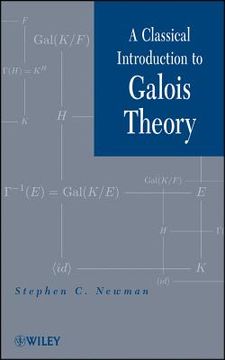
a classical introduction to galois theory
Stephen C. Newman (Autor)
·
wiley
· Libro Físico
a classical introduction to galois theory - stephen c. newman
Libro Nuevo
Importado
Envío: 18 a 25 días háb.
$ 182.27$ 91.14
Costos de importación incluídos en el precio ✅
Reseña del libro "a classical introduction to galois theory"
this book provides an introduction to galois theory and focuses on one central theme - the solvability of polynomials by radicals. both classical and modern approaches to the subject are described in turn in order to have the former (which is relatively concrete and computational) provide motivation for the latter (which can be quite abstract). the theme of the book is historically the reason that galois theory was created, and it continues to provide a platform for exploring both classical and modern concepts. this book examines a number of problems arising in the area of classical mathematics, and a fundamental question to be considered is: for a given polynomial equation (over a given field), does a solution in terms of radicals exist? that the need to investigate the very existence of a solution is perhaps surprising and invites an overview of the history of mathematics. the classical material within the book includes theorems on polynomials, fields, and groups due to such luminaries as gauss, kronecker, lagrange, ruffini and, of course, galois. these results figured prominently in earlier expositions of galois theory, but seem to have gone out of fashion. this is unfortunate since, aside from being of intrinsic mathematical interest, such material provides powerful motivation for the more modern treatment of galois theory presented later in the book. over the course of the book, three versions of the impossibility theorem are presented: the first relies entirely on polynomials and fields, the second incorporates a limited amount of group theory, and the third takes full advantage of modern galois theory. this progression through methods that involve more and more group theory characterizes the first part of the book. the latter part of the book is devoted to topics that illustrate the power of galois theory as a computational tool, but once again in the context of solvability of polynomial equations by radicals.
- 0% (0)
- 0% (0)
- 0% (0)
- 0% (0)
- 0% (0)
Todos los libros de nuestro catálogo son Originales.
✓ Producto agregado correctamente al carro, Ir a Pagar.