60% OFF en Stock Limitado  Ver más

Enviar a
Quito, Pichincha
0
  • argentina
  • chile
  • colombia
  • españa
  • méxico
  • perú
  • estados unidos
  • internacional

Selecciona tu país

América

Europa

Resto del mundo

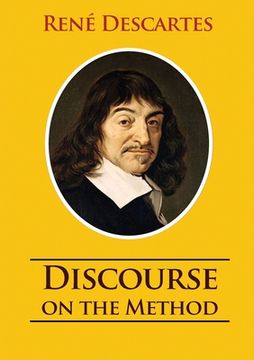
portada Discourse on the Method: unabridged 1637 René Descartes version (en Inglés)
Formato
Libro Físico
Idioma
Inglés
N° páginas
58
Encuadernación
Tapa Blanda
Dimensiones
21x14.8x0.4 cm
Peso
0.09 kg.
ISBN13
9782382742303

Discourse on the Method: unabridged 1637 René Descartes version (en Inglés)

René Descartes (Autor) · Les Prairies Numeriques · Tapa Blanda

Discourse on the Method: unabridged 1637 René Descartes version (en Inglés) - René Descartes

Libro Nuevo Importado
Envío: 16 a 22 días háb.
$ 47.97$ 23.98
-50%
Costos de importación incluídos en el precio ✅
Libro Nuevo

Quedan 50 unidades

$ 23.98
Llega entre el 15 Sep y el 25 Sep a Quito, Pichincha. Seleccionar ubicación

Reseña del libro "Discourse on the Method: unabridged 1637 René Descartes version (en Inglés)"

Discourse on the Method of Rightly Conducting One's Reason and of Seeking Truth in the Sciences (French: Discours de la Méthode Pour bien conduire sa raison, et chercher la vérité dans les sciences) is a philosophical and autobiographical treatise published by René Descartes in 1637. It is best known as the source of the famous quotation 'Je pense, donc je suis' (English: 'I think, therefore I am', or 'I am thinking, therefore I exist'), which occurs in Part IV of the work. The similar Latin statement, Cogito, ergo sum, is found in Meditations on First Philosophy (1641) and Principles of Philosophy (1644). Discourse on the Method is one of the most influential works in the history of modern philosophy, and important to the development of natural sciences. In this work, Descartes tackles the problem of skepticism, which had previously been studied by Sextus Empiricus, Al-Ghazali and Michel de Montaigne. Descartes modified it to account for a truth he found to be incontrovertible. Descartes started his line of reasoning by doubting everything, so as to assess the world from a fresh perspective, clear of any preconceived notions.The book was originally published in Leiden, in the Netherlands. Later, it was translated into Latin and published in 1656 in Amsterdam. The book was intended as an introduction to three works: Dioptrique, Météores and Géométrie. La Géométrie contains Descartes's initial concepts that later developed into the Cartesian coordinate system. The text was written and published in French rather than the language in which philosophical and scientific texts were most frequently written and published in at the time, namely, Latin. Most of Descartes' other works were written in Latin.Together with Meditations on First Philosophy, Principles of Philosophy and Rules for the Direction of the Mind, it forms the base of the epistemology known as Cartesianism. The long chains of simple and easy reasonings by means of which geometers are accustomed to reach the conclusions of their most difficult demonstrations, had led me to imagine that all things, the knowledge of which is competent to man, are mutually connected in the same way, and that there is nothing so far removed from us as to be beyond our reach, or so hidden that we cannot discover it, provided only we abstain from accepting the false for the true, and always preserve in our thoughts the order necessary for the deduction of one truth from another. This treatise on the value of doubt and skepticism when studying the natural world laid the foundation for the modern scientific method as we still employ it today, as well as the basis for modern philosophy. Written in French and first published in 1637 under the full title Discourse on the Method of Rightly Conducting the Reason, and Seeking Truth in the Sciences, it is here presented in the 1901 edition of the 1850 English translation by Scottish poet, philosopher, and historian JOHN VEITCH (1829-1894).
René Descartes
  (Autor)
Ver Página del Autor
René Descartes (1596–1650) fue un filósofo, matemático y científico francés, considerado uno de los padres de la filosofía moderna. Nació en La Haye en Touraine, en una familia acomodada, y recibió una formación sólida en el Colegio de La Flèche, uno de los centros jesuitas más prestigiosos de la época. Su curiosidad por el conocimiento lo llevó a interesarse tanto por las ciencias como por la lógica, alejándose progresivamente de la escolástica tradicional.

En el ámbito filosófico, Descartes es célebre por su método basado en la duda sistemática, cuyo propósito era encontrar un fundamento absolutamente seguro para el conocimiento. De este proceso surgió su famosa afirmación “Cogito, ergo sum” (“Pienso, luego existo”), que se convirtió en la base de su sistema racionalista. Sus obras principales, como Meditaciones metafísicas y Discurso del método, marcaron un antes y un después en la filosofía occidental.

Como matemático, hizo contribuciones fundamentales: estableció la geometría analítica, que unió el álgebra con la geometría al introducir el uso de coordenadas para describir figuras. También aportó al desarrollo del método científico y estudió fenómenos físicos como la óptica y el movimiento.

Descartes pasó buena parte de su vida adulta en los Países Bajos, donde escribió la mayor parte de su obra. Murió en Estocolmo en 1650, invitado por la reina Cristina de Suecia. Su legado continúa influyendo la filosofía, la ciencia y las matemáticas hasta la actualidad.
Ver más
Ver menos

Opiniones del libro

Preguntas frecuentes sobre el libro

Todos los libros de nuestro catálogo son Originales.
El libro está escrito en Inglés.
La encuadernación de esta edición es Tapa Blanda.

Preguntas y respuestas sobre el libro

¿Tienes una pregunta sobre el libro? Inicia sesión para poder agregar tu propia pregunta.

Opiniones sobre Buscalibre

Ver más opiniones de clientes