¡Hasta 60% dto en libros con envío rápido!  Ver más

Enviar a
Quito, Pichincha
0
  • argentina
  • chile
  • colombia
  • españa
  • méxico
  • perú
  • estados unidos
  • internacional

Selecciona tu país

América

Europa

Resto del mundo

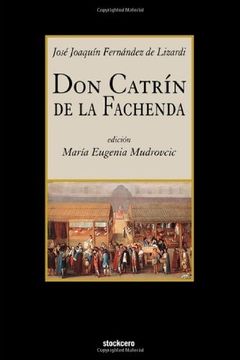
portada Don Catrin de la Fachenda
Formato
Libro Físico
Editorial
Tema
general spanish language ; authors, mexican
Año
2009
Idioma
Español
N° páginas
120
Encuadernación
Tapa Blanda
ISBN13
9781934768297

Don Catrin de la Fachenda

José Joaquín Fernandez de Lizardi (Autor) · Stockcero · Tapa Blanda

Don Catrin de la Fachenda - José Joaquín Fernandez de Lizardi

Libro Nuevo Importado
Envío: 19 a 26 días háb.
$ 59.56$ 29.78
-50%
Costos de importación incluídos en el precio ✅
Libro Nuevo

Quedan 50 unidades

$ 29.78
Llega entre el 14 Jul y el 27 Jul a Quito, Pichincha. Seleccionar ubicación

Reseña del libro "Don Catrin de la Fachenda"

Completed in 1819 and approved by the censorship in 1820, "Don Catrín de la Fachenda" was the last novel written by José J. Fernández de Lizardi, and the only one that remained unpublished until 1832, five years after the death of its author. At first glance, the novel does not seem -at least morally- to doubt: bad characters die, "catrinismo" is sensationally defeated and the truth left standing is monopolized by the clergy, military, and nobility. Perhaps dazzled by the canonization process that Fernández de Lizardi underwent at the hands of liberal historiography towards the end of the 19th century, critics tend to read "Don Catrín de la Fachenda" as the representative of a colonial order that an emergent Mexican nation must destroy in order to advance, free from those elements that halt progress, toward the promising period of liberal modernization. However, one can also trace in the protagonist the signs of the anxiety Lizardi experienced due to the development of a revolution that sooner rather than later would impose what he perceives as a materialist and bourgeois social code. This is probably why all political expectations in the novel rely on those redeemer-characters that form part of a colonial apparatus that Lizardi seems committed to modernize at all costs: clergymen that quote Rousseau, military officials who declare their loyalty to the king and the law, creole-aristocrats that do not speak of a nobility based on blood but of a nobility of virtues, and lettered men who fervently trust in the power of religion, education and work. Displaying what could be classified as a monarchical-constitutional reformism, Lizardi expects such privileged agents to carry out, without violence, the political and social changes needed in New Spain at the beginning of the 19th Century. Far from being in line with a view of Lizardi as revolutionary and liberal, the results of the clash of discourses that occurs within "Don Catrín de la Fachenda" seems to confirm the author's nostalgia for a colonial order in which eternal truth, honor and authority prevail as bastions of the church, the army and the nobility. In the current edition, María Eugenia Mudrovcic undertakes the analysis of Lizardi's last novel as well as provides notes that facilitate an in depth understanding of a text that though entertaining, is complex and contradictory.
José Joaquín Fernandez de Lizardi
  (Autor)
Ver Página del Autor
José Joaquín Fernández de Lizardi (Ciudad de México, 1776–1827), conocido como "El Pensador Mexicano", fue un destacado escritor, periodista y precursor de la novela en Hispanoamérica. Su obra más célebre, El Periquillo Sarniento (1816), es considerada la primera novela escrita en América Latina. Otras obras notables incluyen La Quijotita y su prima (1818), Noches tristes y día alegre (1818) y Don Catrín de la Fachenda (publicada póstumamente en 1832). Estas novelas, enmarcadas en el género picaresco y costumbrista, combinan crítica social con un enfoque moralizante y educativo.

Además de su labor literaria, Fernández de Lizardi fue un ferviente defensor de la libertad de expresión y participó activamente en el movimiento independentista mexicano. En 1812 fundó el periódico El Pensador Mexicano, desde donde criticó abiertamente al gobierno virreinal, lo que le valió la censura y encarcelamiento. Su compromiso con la justicia social y la educación popular lo consolidó como una figura clave en la transición de la Nueva España al México independiente.
Ver más
Ver menos

Opiniones del libro

Preguntas frecuentes sobre el libro

Todos los libros de nuestro catálogo son Originales.
El libro está escrito en Español.
La encuadernación de esta edición es Tapa Blanda.

Preguntas y respuestas sobre el libro

¿Tienes una pregunta sobre el libro? Inicia sesión para poder agregar tu propia pregunta.

Opiniones sobre Buscalibre

Ver más opiniones de clientes