60% OFF en Stock Limitado  Ver más

Enviar a
Quito, Pichincha
0
  • argentina
  • chile
  • colombia
  • españa
  • méxico
  • perú
  • estados unidos
  • internacional

Selecciona tu país

América

Europa

Resto del mundo

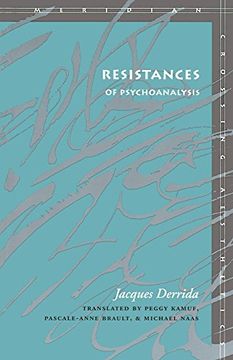
portada Resistances of Psychoanalysis (en Inglés)
Formato
Libro Físico
Año
1998
Idioma
Inglés
N° páginas
130
Encuadernación
Tapa Blanda
Dimensiones
21.6x14.1x1.2 cm
Peso
0.20 kg.
ISBN
9780804730198
ISBN13
9780804730198
N° edición
1

Resistances of Psychoanalysis (en Inglés)

Jacques Derrida (Autor) · Peggy Kamuf (Traducido por) · Pascale-Anne Brault (Traducido por) · Stanford University Press · Tapa Blanda

Resistances of Psychoanalysis (en Inglés) - Jacques Derrida

Libro Nuevo Importado
Envío: 16 a 23 días háb.
$ 63.26$ 31.63
-50%
Costos de importación incluídos en el precio ✅
Libro Nuevo

Quedan más de 100 unidades

$ 31.63
Llega entre el 15 Sep y el 28 Sep a Quito, Pichincha. Seleccionar ubicación

Reseña del libro "Resistances of Psychoanalysis (en Inglés)"

In the three essays that make up this stimulating and often startling book, Jacques Derrida argues against the notion that the basic ideas of psychoanalysis have been thoroughly worked through, argued, and assimilated. The continuing interest in psychoanalysis is here examined in the various "resistances" to analysis--conceived not only as a phenomenon theorized at the heart of psychoanalysis, but as psychoanalysis's resistance to itself, an insusceptibility to analysis that has to do with the structure of analysis itself. Derrida not only shows how the interest of psychoanalysis and psychoanalytic writing can be renewed today, but these essays afford him the opportunity to revisit and reassess a subject he first confronted (in an essay on Freud) in 1966. They also serve to clarify Derrida's thinking about the subjects of the essays--Freud, Lacan, and Foucault--a thinking that, especially with regard to the last two, has been greatly distorted and misunderstood. The first essay, on Freud, is a tour de force of close reading of Freud's texts as philosophical reflection. By means of the fine distinctions Derrida makes in this analytical reading, particularly of The Interpretation of Dreams, he opens up the realm of analysis into new and unpredictable forms--such as meeting with an interdiction (when taking an analysis further is "forbidden" by a structural limit). Following the essay that might be dubbed Derrida's "return to Freud," the next is devoted to Lacan, the figure for whom that phrase was something of a slogan. In this essay and the next, on Foucault, Derrida reencounters two thinkers to whom he had earlier devoted important essays, which precipitated stormy discussions and numerous divisions within the intellectual milieus influenced by their writings. In this essay, which skillfully integrates the concept of resistance into larger questions, Derrida asks in effect: What is the origin and nature of the text that constitutes Lacanian psychoanalysis, considering its existence as an archive, as teachings, as seminars, transcripts, quotations, etc.? Derrida's third essay may be called not simply a criticism but an appreciation of Foucault's work: an appreciation not only in the psychological and rhetorical sense, but also in the sense that it elevates Foucault's thought by giving back to it ranges and nuances lost through its reduction by his readers, his own texts, and its formulaic packaging.
Jacques Derrida
  (Autor)
Ver Página del Autor
Jacques Derrida nació el 15 de julio de 1930 en El Biar, Argelia, y murió el 8 de octubre de 2004 en París, Francia. Proveniente de una familia judía sefardí en el contexto del colonialismo francés, su infancia estuvo marcada por acontecimientos que influirían en su sensibilidad filosófica: entre ellos, la experiencia de ser excluido de su liceo en 1942 debido a decretos antijudíos del régimen de Vichy. Posteriormente se trasladó a París para formarse en filosofía, y tras ejercer la enseñanza en la Sorbona y en la École Normale Supérieure, se consolidó como uno de los más influyentes filósofos del siglo XX.

Derrida es sobretodo conocido por haber desarrollado la filosofía de la deconstrucción, un método crítico que analiza cómo los textos, discursos o sistemas de pensamiento contienen oposiciones jerárquicas implícitas (como presencia/ausencia, palabra/escritura, naturaleza/cultura) y muestra cómo esas oposiciones pueden desplazarse o derrumbarse. Su trabajo influyó profundamente en áreas como filosofía, teoría literaria, lingüística, derecho, arquitectura y estudios culturales, sirviendo para cuestionar los fundamentos de la metafísica occidental.

Entre sus obras más destacadas se encuentran Of Grammatology (1967), Writing and Difference (1967) y Margins of Philosophy (1972). A lo largo de su vida académica, abordó temas como la escritura, la diferencia, la presencia, la identidad, la justicia, la memoria y la alteridad. Su estilo, complejo y frecuentemente polémico, generó tanto adhesiones como críticas intensas. Derrida deja un legado que sigue vivo en múltiples disciplinas, movilizando el pensamiento en torno a la apertura, el otro y el procedimiento crítico.
Ver más
Ver menos

Opiniones del libro

Preguntas frecuentes sobre el libro

Todos los libros de nuestro catálogo son Originales.
El libro está escrito en Inglés.
La encuadernación de esta edición es Tapa Blanda.

Preguntas y respuestas sobre el libro

¿Tienes una pregunta sobre el libro? Inicia sesión para poder agregar tu propia pregunta.

Opiniones sobre Buscalibre

Ver más opiniones de clientes