60% OFF en Stock Limitado  Ver más

Enviar a
Quito, Pichincha
0
  • argentina
  • chile
  • colombia
  • españa
  • méxico
  • perú
  • estados unidos
  • internacional

Selecciona tu país

América

Europa

Resto del mundo

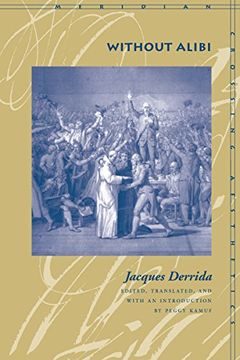
portada Without Alibi (Meridian: Crossing Aesthetics) (en Inglés)
Formato
Libro Físico
Traducido por
Año
2002
Idioma
Inglés
N° páginas
319
Encuadernación
Tapa Blanda
Dimensiones
22.6x15x2 cm
Peso
0.45 kg.
ISBN
0804744114
ISBN13
9780804744119
N° edición
1

Without Alibi (Meridian: Crossing Aesthetics) (en Inglés)

Jacques Derrida (Autor) · Peggy Kamuf (Traducido por) · Stanford University Press · Tapa Blanda

Without Alibi (Meridian: Crossing Aesthetics) (en Inglés) - Jacques Derrida

Libro Nuevo Importado
Envío: 15 a 22 días háb.
$ 70.76$ 35.38
-50%
Costos de importación incluídos en el precio ✅
Libro Nuevo

Quedan más de 100 unidades

$ 35.38
Llega entre el 14 Sep y el 25 Sep a Quito, Pichincha. Seleccionar ubicación

Reseña del libro "Without Alibi (Meridian: Crossing Aesthetics) (en Inglés)"

This book brings together for the first time five recent essays by Jacques Derrida, which advance his reflections on many issues: lying, perjury, forgiveness, confession, the profession of faith, and, most recently, cruelty, sovereignty, and capital punishment. Strongly linked by their attention to "performatives" and the "as if," the essays show the necessity of thinking beyond the category of acts that are possible for a subject. Derrida argues forcefully that thought must engage with the im-possible, that is, the order of the unforeseeable event, the absolute future still to come. This acute awareness of the limits of performative programs informs the essays throughout and attunes them closely to events of a world undergoing "globalization." The first essay, "History of the Lie," reviews some classic and modern definitions of the lie (Augustine, Rousseau, Kant, Koyré, Arendt), while renewing questions about what is called lying, as distinguished from other forms of nontruth. This inventive analysis is followed by "Typewriter Ribbon," which examines at length the famous lie recounted by Rousseau in his Confessions, when he perjured himself by accusing another of his own crime. Paul de Man's reading of this textual event is at the center of Derrida's patient, at times seriously funny analyses. "Le parjure, Perhaps" engages with a remarkable novel by Henri Thomas that fictionalizes the charge of perjury brought against Paul de Man in the 1950s. Derrida's extraordinary fineness as a reader and thinker of fiction here treats, to profound effect, the "fatal experience of perjury." The two final essays, "The University Without Condition" and "Psychoanalysis Searches the States of Its Soul," address the institutions of the university and of psychoanalysis as sites from which to resist and deconstruct the nontruth or phantasm of sovereignty. For the university, the principle of truth remains at the core of its resistance; for psychoanalysis, there is the obligation to remain true to what may be, Derrida suggests, its specific insight: into psychic cruelty. Resistance to the sovereign cruelty of the death penalty is just one of the stakes indicated by the last essay, which is the text of a keynote address to the "States General of Psychoanalysis" held in Paris, July 2000. Especially for this volume, Derrida has written "Provocation: Forewords," which reflects on the title Without Alibi while taking up questions about relations between deconstruction and America. This essay-foreword also responds to the event of this book, which Peggy Kamuf in her introduction presents as event of resistance. Without Alibi joins two other books by Derrida that Kamuf has translated for Stanford University Press: Points . . .: Interviews, 1974-1994 (1994) and Resistances of Psychoanalysis (1998).
Jacques Derrida
  (Autor)
Ver Página del Autor
Jacques Derrida nació el 15 de julio de 1930 en El Biar, Argelia, y murió el 8 de octubre de 2004 en París, Francia. Proveniente de una familia judía sefardí en el contexto del colonialismo francés, su infancia estuvo marcada por acontecimientos que influirían en su sensibilidad filosófica: entre ellos, la experiencia de ser excluido de su liceo en 1942 debido a decretos antijudíos del régimen de Vichy. Posteriormente se trasladó a París para formarse en filosofía, y tras ejercer la enseñanza en la Sorbona y en la École Normale Supérieure, se consolidó como uno de los más influyentes filósofos del siglo XX.

Derrida es sobretodo conocido por haber desarrollado la filosofía de la deconstrucción, un método crítico que analiza cómo los textos, discursos o sistemas de pensamiento contienen oposiciones jerárquicas implícitas (como presencia/ausencia, palabra/escritura, naturaleza/cultura) y muestra cómo esas oposiciones pueden desplazarse o derrumbarse. Su trabajo influyó profundamente en áreas como filosofía, teoría literaria, lingüística, derecho, arquitectura y estudios culturales, sirviendo para cuestionar los fundamentos de la metafísica occidental.

Entre sus obras más destacadas se encuentran Of Grammatology (1967), Writing and Difference (1967) y Margins of Philosophy (1972). A lo largo de su vida académica, abordó temas como la escritura, la diferencia, la presencia, la identidad, la justicia, la memoria y la alteridad. Su estilo, complejo y frecuentemente polémico, generó tanto adhesiones como críticas intensas. Derrida deja un legado que sigue vivo en múltiples disciplinas, movilizando el pensamiento en torno a la apertura, el otro y el procedimiento crítico.
Ver más
Ver menos

Opiniones del libro

Preguntas frecuentes sobre el libro

Todos los libros de nuestro catálogo son Originales.
El libro está escrito en Inglés.
La encuadernación de esta edición es Tapa Blanda.

Preguntas y respuestas sobre el libro

¿Tienes una pregunta sobre el libro? Inicia sesión para poder agregar tu propia pregunta.

Opiniones sobre Buscalibre

Ver más opiniones de clientes