Summer Deals! Hasta 50% dto  Ver más

Enviar a
Quito, Pichincha
0
  • argentina
  • chile
  • colombia
  • españa
  • méxico
  • perú
  • estados unidos
  • internacional

Selecciona tu país

América

Europa

Resto del mundo

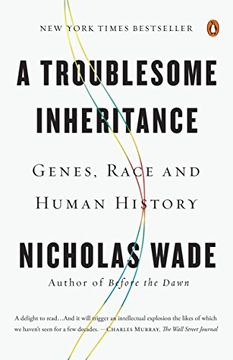
portada A Troublesome Inheritance: Genes, Race and Human History (en Inglés)
Formato
Libro Físico
Editorial
Año
2015
Idioma
Inglés
N° páginas
288
Encuadernación
Tapa Blanda
ISBN13
9780143127161
Categorías

A Troublesome Inheritance: Genes, Race and Human History (en Inglés)

Nicholas Wade (Autor) · Penguin · Tapa Blanda

A Troublesome Inheritance: Genes, Race and Human History (en Inglés) - Nicholas Wade

Libro Nuevo Importado
Envío: 16 a 23 días háb.
$ 49.52$ 27.23
-45%
Costos de importación incluídos en el precio ✅
Libro Nuevo

Quedan 5 unidades

$ 27.23
Llega entre el 21 Ago y el 03 Sep a Quito, Pichincha. Seleccionar ubicación

Reseña del libro "A Troublesome Inheritance: Genes, Race and Human History (en Inglés)"

Drawing on startling new evidence from the mapping of the genome, an explosive new account of the genetic basis of race and its role in the human story Fewer ideas have been more toxic or harmful than the idea of the biological reality of race, and with it the idea that humans of different races are biologically different from one another. For this understandable reason, the idea has been banished from polite academic conversation. Arguing that race is more than just a social construct can get a scholar run out of town, or at least off campus, on a rail. Human evolution, the consensus view insists, ended in prehistory.Inconveniently, as Nicholas Wade argues in A Troublesome Inheritance, the consensus view cannot be right. And in fact, we know that populations have changed in the past few thousand years—to be lactose tolerant, for example, and to survive at high altitudes. Race is not a bright-line distinction; by definition it means that the more human populations are kept apart, the more they evolve their own distinct traits under the selective pressure known as Darwinian evolution. For many thousands of years, most human populations stayed where they were and grew distinct, not just in outward appearance but in deeper senses as well.Wade, the longtime journalist covering genetic advances for The New York Times, draws widely on the work of scientists who have made crucial breakthroughs in establishing the reality of recent human evolution. The most provocative claims in this book involve the genetic basis of human social habits. What we might call middle-class social traits—thrift, docility, nonviolence—have been slowly but surely inculcated genetically within agrarian societies, Wade argues. These “values” obviously had a strong cultural component, but Wade points to evidence that agrarian societies evolved away from hunter-gatherer societies in some crucial respects. Also controversial are his findings regarding the genetic basis of traits we associate with intelligence, such as literacy and numeracy, in certain ethnic populations, including the Chinese and Ashkenazi Jews.Wade believes deeply in the fundamental equality of all human peoples. He also believes that science is best served by pursuing the truth without fear, and if his mission to arrive at a coherent summa of what the new genetic science does and does not tell us about race and human history leads straight into a minefield, then so be it. This will not be the last word on the subject, but it will begin a powerful and overdue conversation.
Nicholas Wade
  (Autor)
Ver Página del Autor
Nicholas Wade (nacido en 1942) es un periodista y autor científico británico. Estudió Ciencias Naturales en la Universidad de Cambridge. Su trayectoria profesional destaca por haber sido editor y redactor en prestigiosas revistas como Nature y Science, así como editor de la sección de ciencia en The New York Times hasta su retiro.A lo largo de su carrera, ha escrito varios libros sobre evolución y genética. Sin embargo, su obra ha generado fuertes debates y controversias. Su libro de 2014, Una herencia incómoda, el cual aborda la genética humana y la raza, fue ampliamente criticado por la comunidad científica. Más recientemente, en 2021, Wade publicó un extenso artículo apoyando la controvertida hipótesis de que el COVID-19 pudo haberse originado por una fuga de laboratorio en Wuhan, una teoría que también generó un intenso debate en la comunidad médica y científica
Ver más
Ver menos

Opiniones del libro

Preguntas frecuentes sobre el libro

Todos los libros de nuestro catálogo son Originales.
El libro está escrito en Inglés.
La encuadernación de esta edición es Tapa Blanda.

Preguntas y respuestas sobre el libro

¿Tienes una pregunta sobre el libro? Inicia sesión para poder agregar tu propia pregunta.

Opiniones sobre Buscalibre

Ver más opiniones de clientes