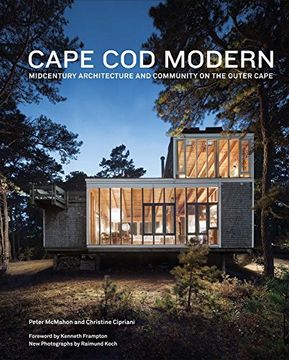
Cape cod Modern: Midcentury Architecture and Community on the Outer Cape (en Inglés)
Reseña del libro "Cape cod Modern: Midcentury Architecture and Community on the Outer Cape (en Inglés)"
From the "summer Bauhaus" on, the Cape's modern designers enjoyed a lifestyle based on communion with nature, solitary creativity and shared festivityIn the summer of 1937, Walter Gropius, founder of the Bauhaus and a professor at Harvard's new Graduate School of Design, rented a house on Planting Island, near the base of Cape Cod. There, he and his wife, Ise, hosted a festive reunion of Bauhaus masters and students who had recently emigrated from Europe: Marcel Breuer, Herbert Bayer, László Moholy-Nagy, Xanti Schawinsky and others. Together they feasted, swam and planned their futures on a new continent, all sensing they were on the cusp of a momentous new phase in their lives. Yet even as they moved on, the group never lost its connection to the Cape Cod coast. Several members returned, when they had the means, to travel farther up the peninsula, rent cabins, buy land and design their ideal summer homes. Thus began a chapter in the history of modern architecture that has never been told--until now. The flow of talent onto the Outer Cape continued and, within a few years, the area was a hotbed of intellectual currents from New York, Boston, Cambridge and the country's top schools of architecture and design. Avant-garde homes began to appear in the woods and on the dunes; by the 1970s, there were about 100 modern houses of interest here. In this story, we meet, among others, the Boston Brahmins Jack Phillips and Nathaniel Saltonstall; the self-taught architect, carpenter and painter Jack Hall; the Finn Olav Hammarström, who had worked for Alvar Aalto; and the prolific Charlie Zehnder, who brought the lessons of both Frank Lloyd Wright and Brutalism to the Cape. Initially, these designers had no clients; they built for themselves and their families, or for friends sympathetic to their ideals. Their homes were laboratories, places to work through ideas without spending much money. The result of this ferment is a body of work unlike any other, a regional modernism fusing the building traditions of Cape Cod fishing towns with Bauhaus concepts and postwar experimentation.
Kenneth Frampton (1930) estudió arquitectura en la Architectural Association de Londres y ha sido profesor en universidades de todo el mundo. Autor de numerosos libros y ensayos sobre historia y teoría de la arquitectura, entre ellos se encuentra su célebre Historia crítica de la arquitectura moderna (1980), así como sus más recientes Estudios sobre cultura tectónica (1995) y la recopilación de ensayos Labour, Work and Architecture (2002). En 2018 fue galardonado por su trayectoria profesional con el León de Oro en la XVI Bienal de Arquitectura de Venecia.
Ver más
Ver menos