¡Envío express a un clic!  Ver más

Enviar a
Quito, Pichincha
0
  • argentina
  • chile
  • colombia
  • españa
  • méxico
  • perú
  • estados unidos
  • internacional

Selecciona tu país

América

Europa

Resto del mundo

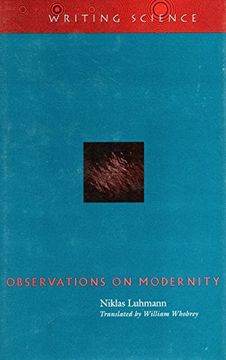
portada Observations on Modernity (en Inglés)
Formato
Libro Físico
Año
1998
Idioma
Inglés
N° páginas
160
Encuadernación
Tapa Blanda
Peso
0.45
ISBN
0804732353
ISBN13
9780804732352
N° edición
1
Categorías

Observations on Modernity (en Inglés)

Niklas Luhmann (Autor) · Stanford Univ Pr · Tapa Blanda

Observations on Modernity (en Inglés) - Niklas Luhmann

Libro Nuevo Importado
Envío: 15 a 22 días háb.
$ 78.47$ 39.24
-50%
Costos de importación incluídos en el precio ✅
Libro Nuevo

Quedan más de 100 unidades

$ 39.24
Llega entre el 10 Sep y el 23 Sep a Quito, Pichincha. Seleccionar ubicación

Reseña del libro "Observations on Modernity (en Inglés)"

This collection of five essays by Germany’s most prominent and influential social thinker both links Luhmann’s social theory to the question “What is modern about modernity?” and shows the origins and context of his theory.In the introductory essay, “Modernity in Contemporary Society,” Luhmann develops the thesis that the modern epistemological situation can be seen as the consequence of a radical change in social macrostructures that he calls “social differentiation,” thereby designating the juxtaposition of and interaction between a growing number of social subsystems without any hierarchical structure. “European Rationality” defines rationality as the capacity to see the difference between systems and their environment as a unity. Luhmann argues that, in a world characterized by contingency, rationality tends to become coextensive with imagination, a view that challenges their classical binary opposition and opens up the possibility of seeing modern rationality as a paradox. In the third essay, “Contingency as Modern Society’s Defining Attribute,” Luhmann develops a further and probably even more important paradox: that the generalization of contingency or cognitive uncertainty is precisely what provides stability within modern societies. In the process, he argues that medieval and early modern theology can be seen as a “preadaptive advance” through which Western thinking prepared itself for the modern epistemological situation. In “Describing the Future,” Luhmann claims that neither the traditional hope of learning from history nor the complementary hope of cognitively anticipating the future can be maintained, and that the classical concept of the future should be replaced by the notion of risk, defined as juxtaposing the expectation of realizing certain projects and the awareness that such projects might fail. The book concludes with “The Ecology of Ignorance,” in which Luhmann outlines prospective research areas “for sponsors who have yet to be identified.”
Niklas Luhmann
  (Autor)
Ver Página del Autor
Niklas Luhmann (1927-1998), realizó estudios de derecho en la Universidad de Friburgo y obtuvo el grado de doctor. Es considerado uno de los pioneros más destacados de la Teoría Sociológica de Sistemas, cuya propuesta renovadora contrastaba con la de Talcott Parsons, el teórico más renombrado en la materia durante la década de 1960, de quien fue alumno en la Universidad de Harvard. Ocupó cargos diversos en las Universidades de Münster, de Frankfurt y finalmente en la de Bielefeld, en la que permaneció hasta su retiro en 1993. Su prolífica labor como escritor de temas tan diversos como el derecho, la economía, la política, el arte, la ecología o los medios de comunicación masiva, continuó aún después de esta fecha hasta sellar con su obra más importante: La sociedad de la sociedad, aparecida en 1997.
Ver más
Ver menos

Opiniones del libro

Preguntas frecuentes sobre el libro

Todos los libros de nuestro catálogo son Originales.
El libro está escrito en Inglés.
La encuadernación de esta edición es Tapa Blanda.

Preguntas y respuestas sobre el libro

¿Tienes una pregunta sobre el libro? Inicia sesión para poder agregar tu propia pregunta.

Opiniones sobre Buscalibre

Ver más opiniones de clientes